01 · A
Problem
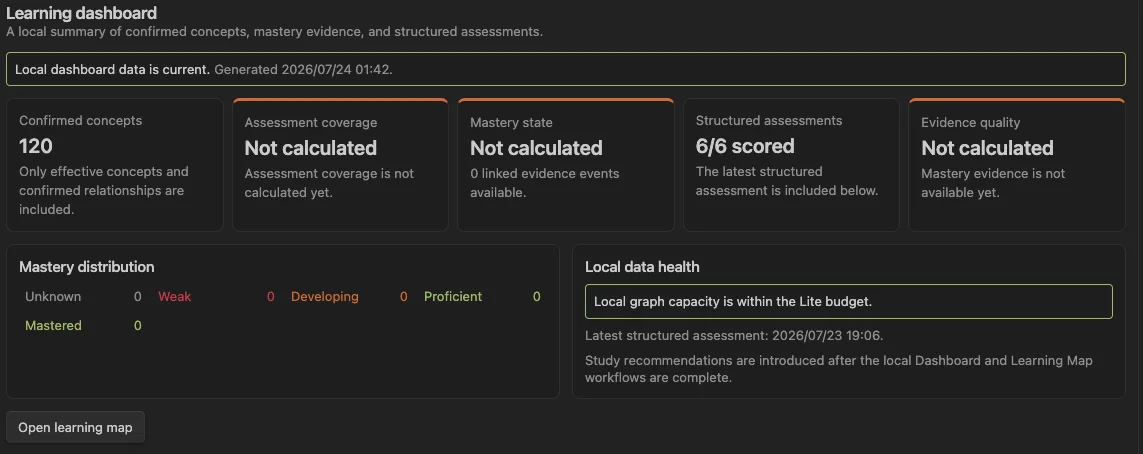
Search can retrieve a note without helping a learner practise or retain it. The product needed to connect answers to evidence and learning actions without silently turning model output into truth.
Local-first active learning
An Obsidian learning companion that connects source-grounded retrieval, practice, mastery feedback and a reviewable concept-evidence graph.
TL;DR
01 · A
Search can retrieve a note without helping a learner practise or retain it. The product needed to connect answers to evidence and learning actions without silently turning model output into truth.
01 · B
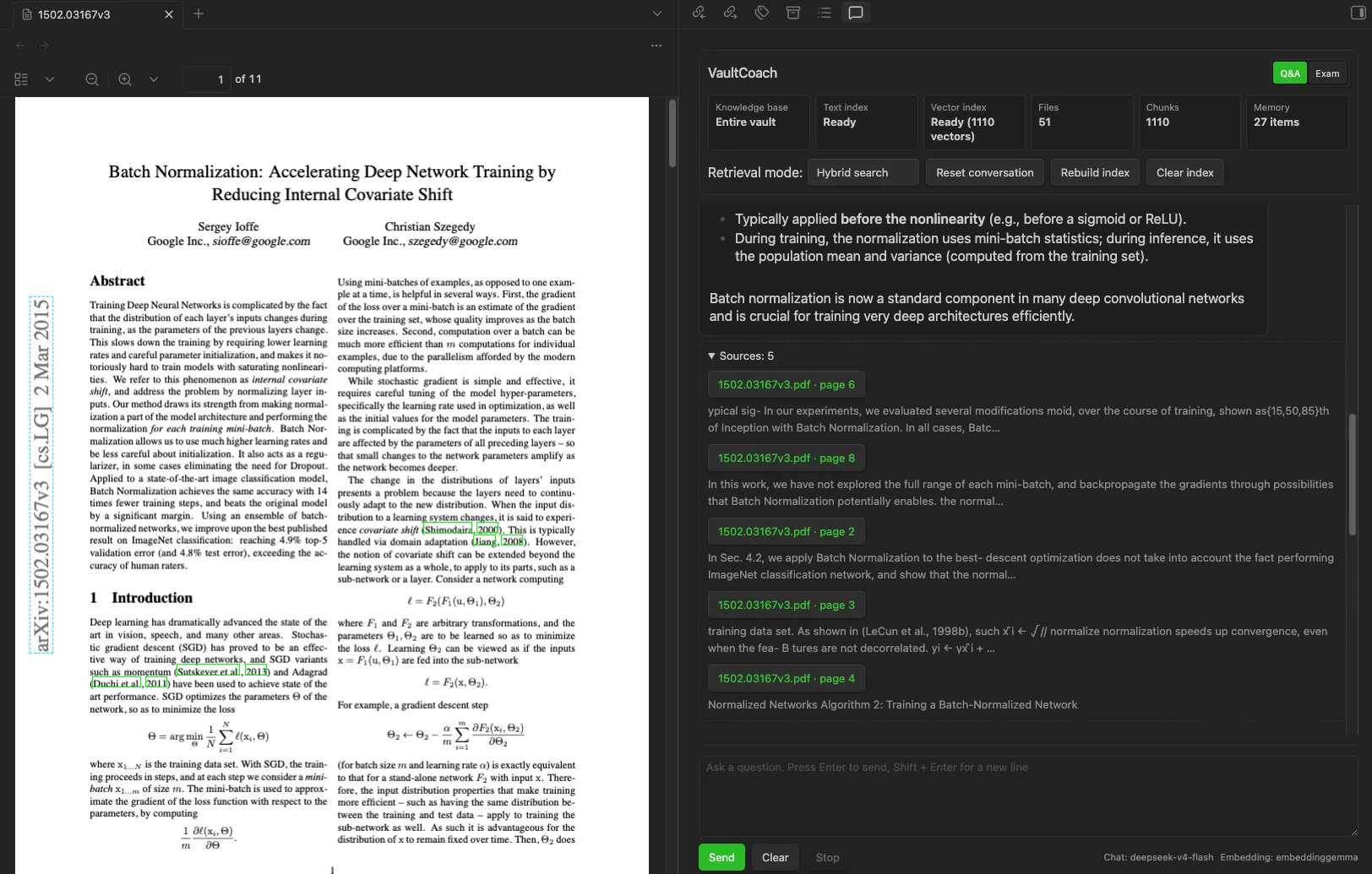
The plugin runs inside Obsidian, adapts to vault files and local stores, and uses a bundled multilingual embedding model in an isolated WASM worker.
A learning agent is useful only when learners can trace an answer to evidence, practise recall and decide which machine-proposed relations become trusted knowledge.
Keep user knowledge in the vault unless a configured model call needs selected context.
Preserve source locations across Markdown and text-based PDF chunks.
Review model-proposed semantic relations before they affect the effective graph.
Recover interrupted local writes and invalidate stale derived data.
System path
Parse vault content and maintain incremental text/vector indexes
Fuse keyword and vector rankings while preserving source locations
Generate exams, record assessment facts and derive mastery views
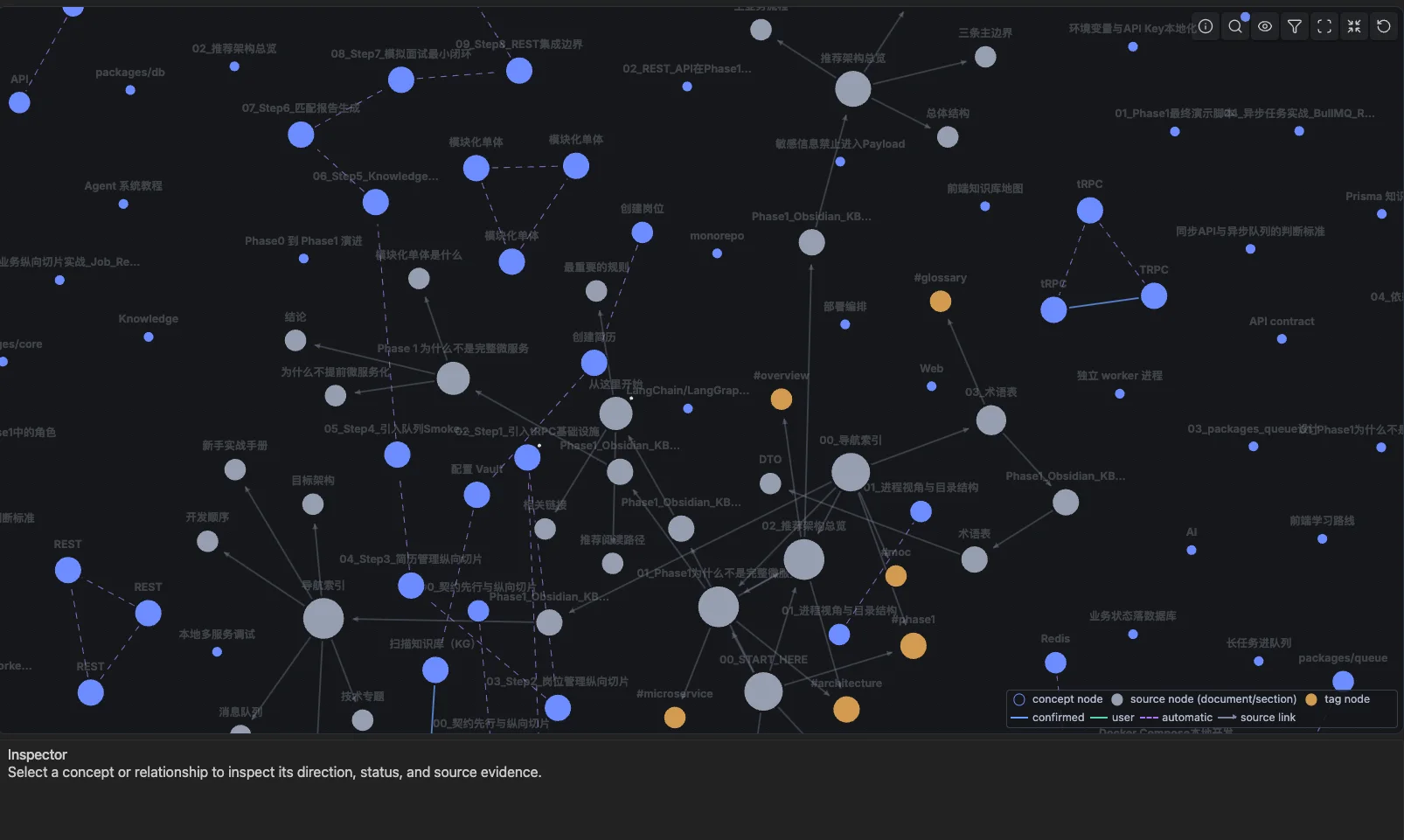
Confirm, reject or undo proposed concept-evidence relations
Grounded retrieval
Keyword search captures exact language, vector search captures semantic similarity, and reciprocal-rank fusion combines rank positions without pretending the raw scores share one scale.
User intent and current context
Exact terms and document language
Bundled local embedding representation
Fuse rank positions, not raw magnitudes
Return passages with page/note links
Key trade-offs
Keyword and vector rankings stay independent before reciprocal-rank fusion; raw scores are not treated as one scale.
Deterministic structure, model proposals, user decisions and the effective graph remain separate layers.
Assessment records are authoritative; mastery and recommendations are reproducible derived views.
04 · A
04 · B
Graph governance
The effective graph contains deterministic structure and explicitly accepted relations. Rejected and pending proposals remain inspectable without becoming trusted knowledge.
Documents, headings and explicit links
Candidate concept or evidence relation
Confirm, reject or undo
Only accepted relations affect learning views
01Local-first describes data ownership, not a promise that every configured model stays offline.
02A knowledge graph becomes trustworthy through governance states, not by drawing more edges.
What I can share
This is my open-source Obsidian project. Its production path uses WASM rather than WebGPU. The public marketplace and GitHub figures describe reach, not learning effect.
Public sources