01 · A
Problem
Enterprise manuals are long, terminology-heavy and distributed across sections. A fluent answer is not useful unless the system retrieved the right evidence and the user can inspect it.
Requirements, prototype and evaluation
A Design Science thesis on turning technical-manual questions into a source-grounded local RAG prototype and a separated retrieval/answer evaluation plan.
TL;DR

01 · A
Enterprise manuals are long, terminology-heavy and distributed across sections. A fluent answer is not useful unless the system retrieved the right evidence and the user can inspect it.
01 · B
I used a Design Science process spanning user needs, architecture, a local retrieval-and-generation prototype, technical evaluation and user feedback.
I use this workflow illustration to show a cited answer beside ranked passages, with retrieval quality separated from answer quality.
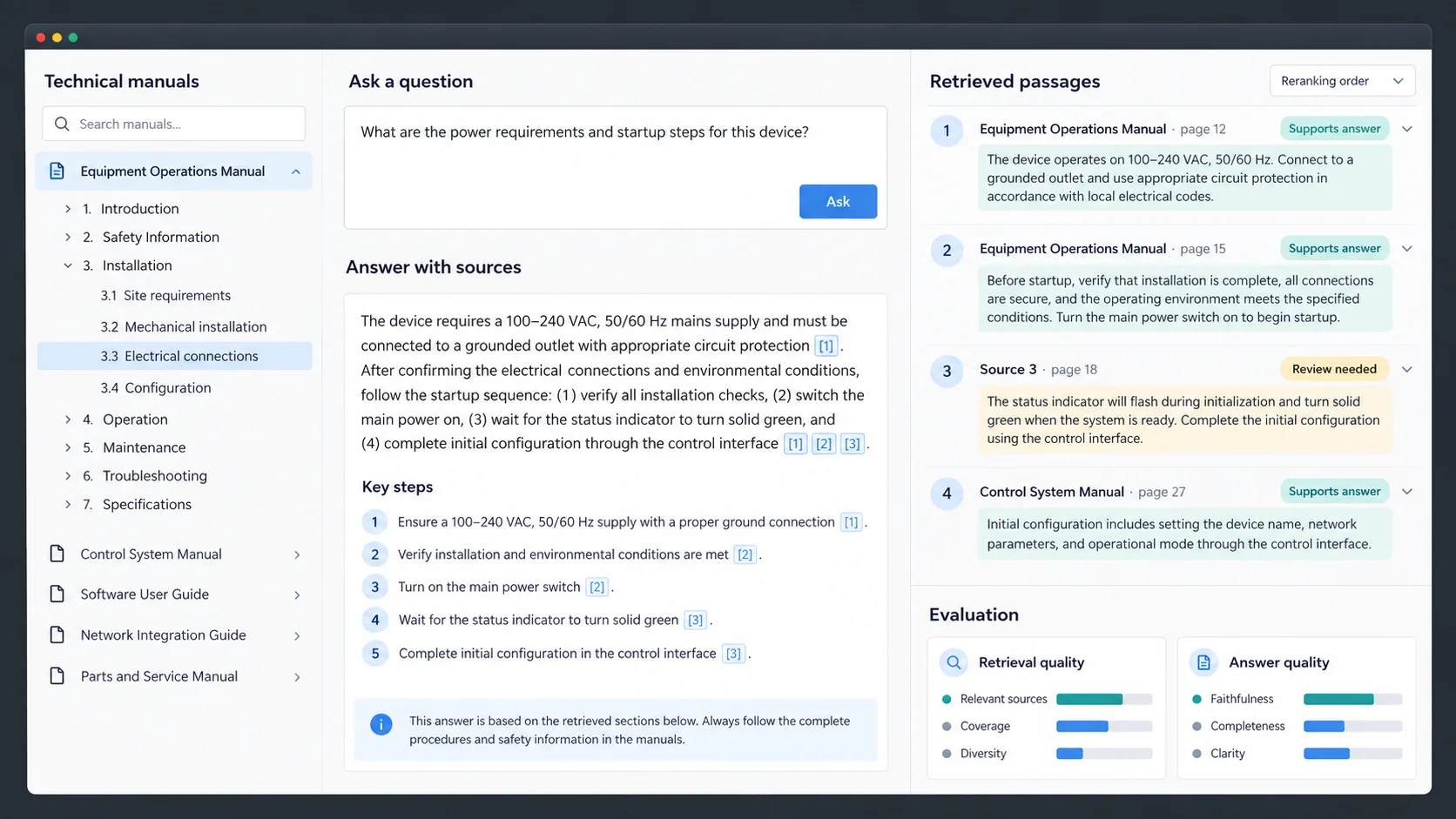
A compelling demo cannot establish that an enterprise knowledge system works. Retrieval relevance, answer support and user trust are different questions and need different evidence.
User language and manual terminology do not always match.
High vector similarity does not guarantee a passage can answer the question.
Retrieval and answer quality need separate evaluation.
Expert-created questions and relevant sources are needed for a domain benchmark.
System path
Translate user needs into retrieval, citation and local-deployment requirements
Combine local embeddings, lexical signals and reranking
Generate from selected passages while retaining source traceability
Separate technical retrieval/answer checks from interviews and feedback
Grounded answer path
The prototype first gathers and reranks support material, then generates from selected passages while keeping source identities attached.
Natural language differs from manual terminology
Lexical and local embedding candidates
Reorder passages for the specific question
Generate only from selected context
Expose supporting sections for inspection
Key trade-offs
Design Science keeps the prototype tied to user tasks rather than one preferred model.
Finding the wrong passage and answering badly from the right passage are measured separately.
The system cannot create its own benchmark and then treat that benchmark as independent evidence.
04 · A
04 · B
Evaluation design
Separating the layers makes failure diagnosis possible and prevents a single aggregate score from hiding where the system broke.
Did the system find the expert-relevant material?
Is the response supported, complete and appropriate?
Is the workflow understandable and useful?
To protect confidential thesis materials, I do not include participant counts or detailed metrics here.
01RAG is a system of source, failure-mode and trust decisions—not only a vector database.
02User feedback explains experience; it does not replace technical retrieval evidence.
What I can share
The company manuals, repository and user-study materials are confidential, so I cannot publish them. I can share the research design, local RAG architecture and evaluation method; specific participant and benchmark numbers remain private.
Public sources