01 · A
Problem
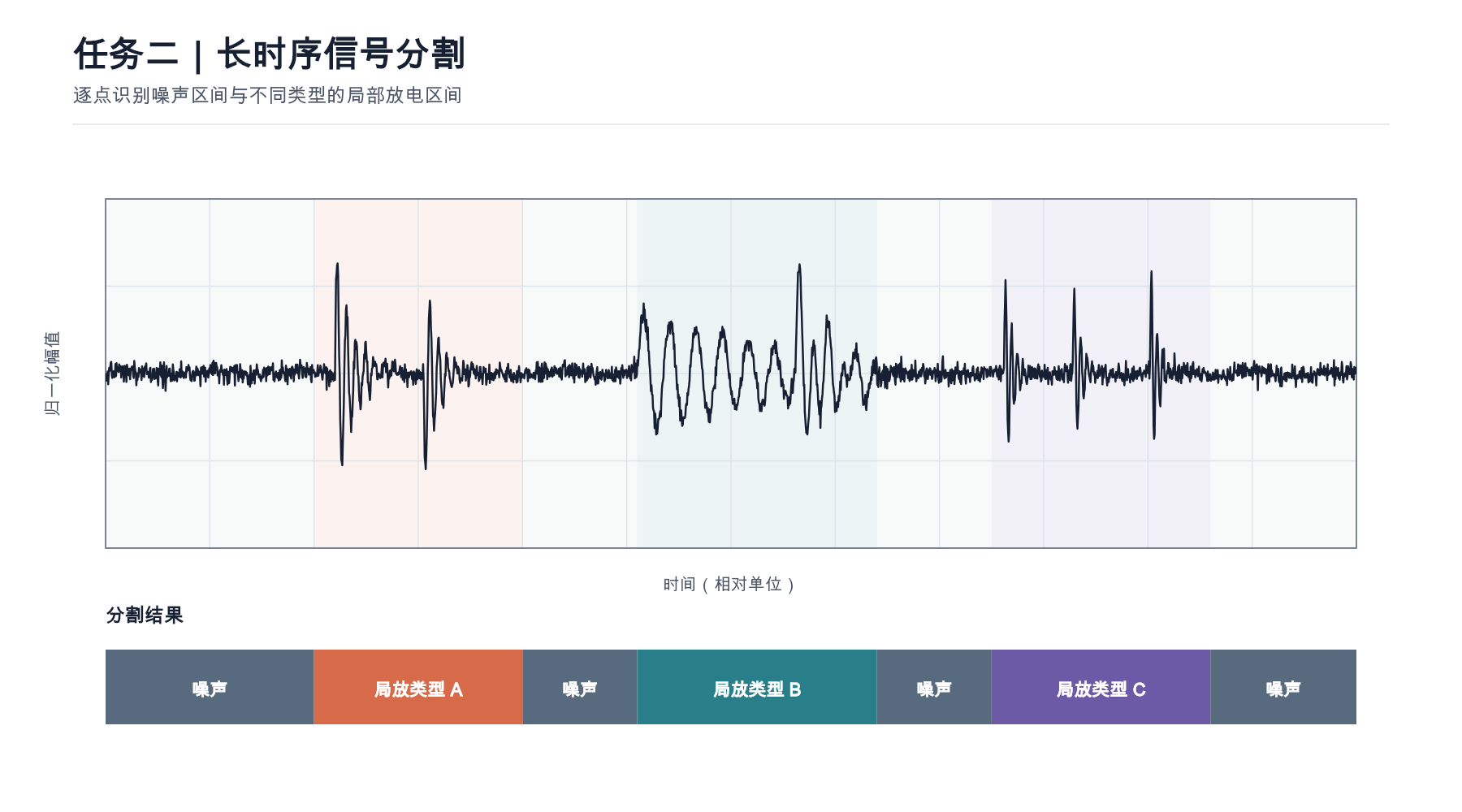
Short windows need a class and confidence; long records need start and end positions for every signal regime. Treating both as one classification problem loses the temporal boundaries engineers must review.
From waveform to inspectable intervals
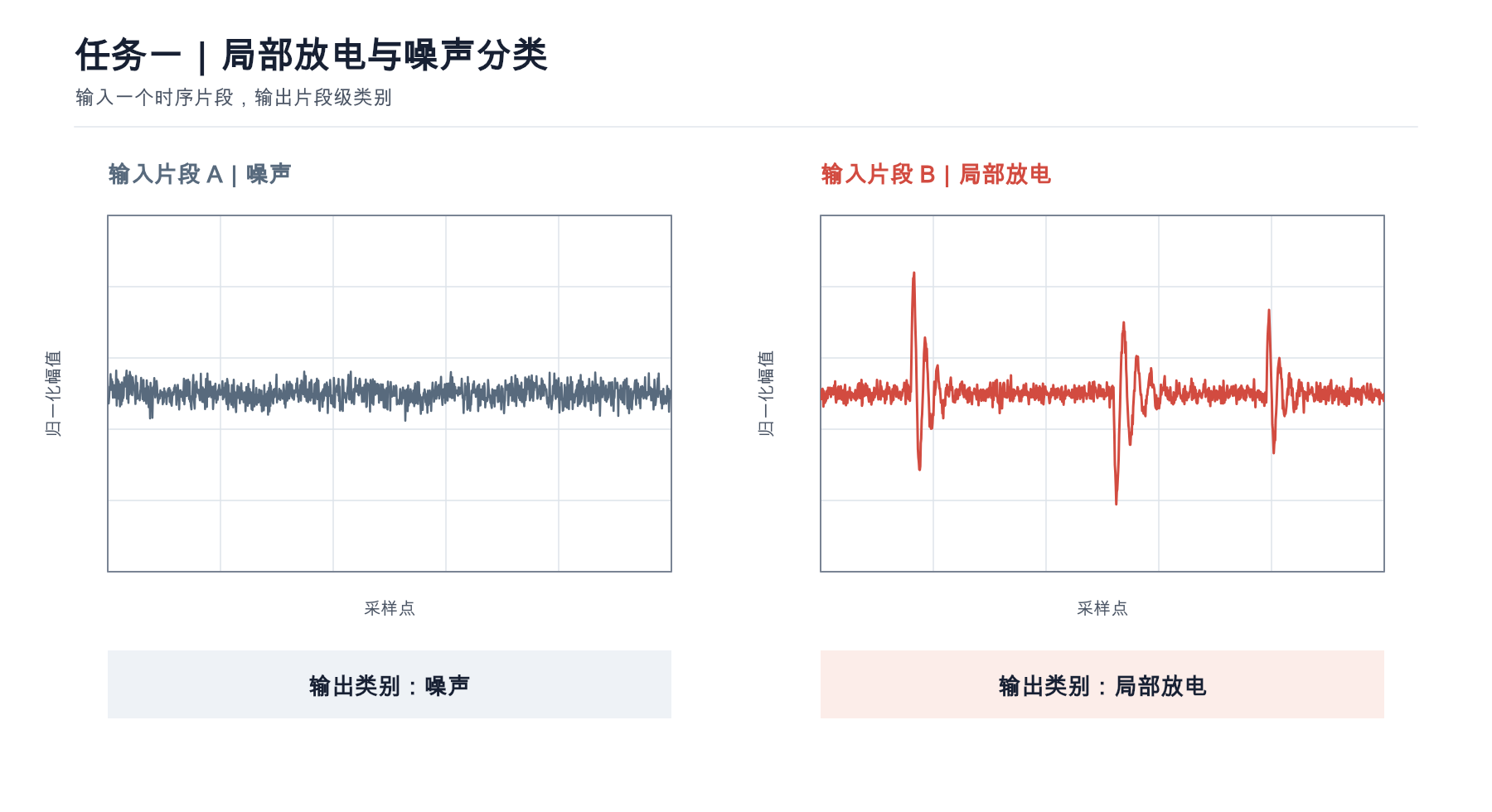
Two related but distinct tasks: classify short segments as partial discharge or noise, then segment long records into intervals of different discharge types and noise.
TL;DR
01 · A
Short windows need a class and confidence; long records need start and end positions for every signal regime. Treating both as one classification problem loses the temporal boundaries engineers must review.
01 · B
At an anonymized industrial measurement technology company, expert labels from the annotation workflow fed model experiments. Deployment exposed a scale mismatch between laboratory-style inputs and customer measurements; the public account keeps the device and customer context private.
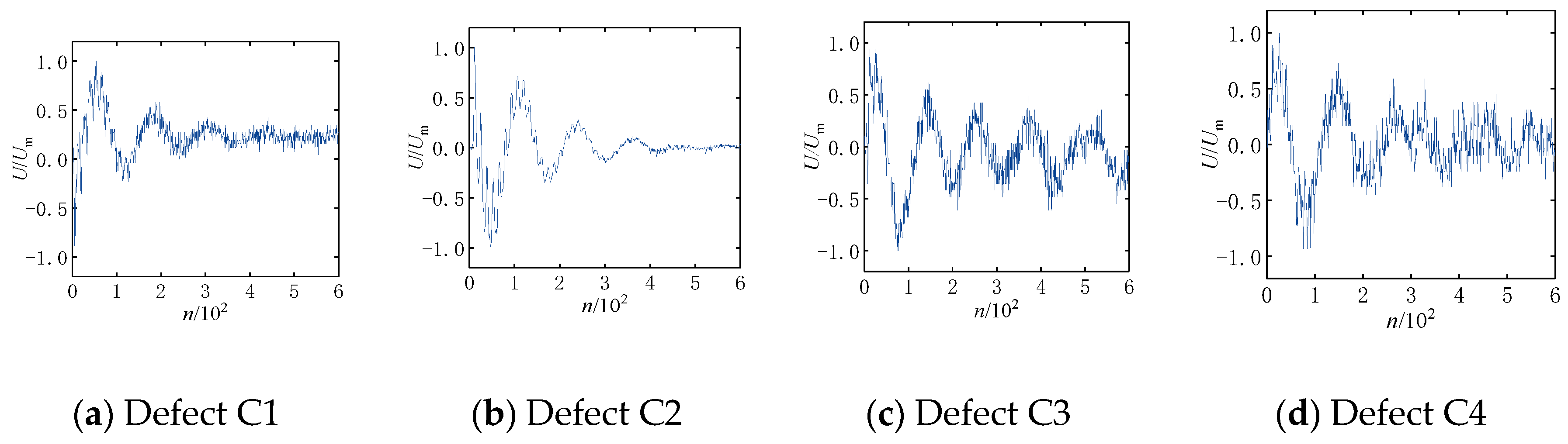
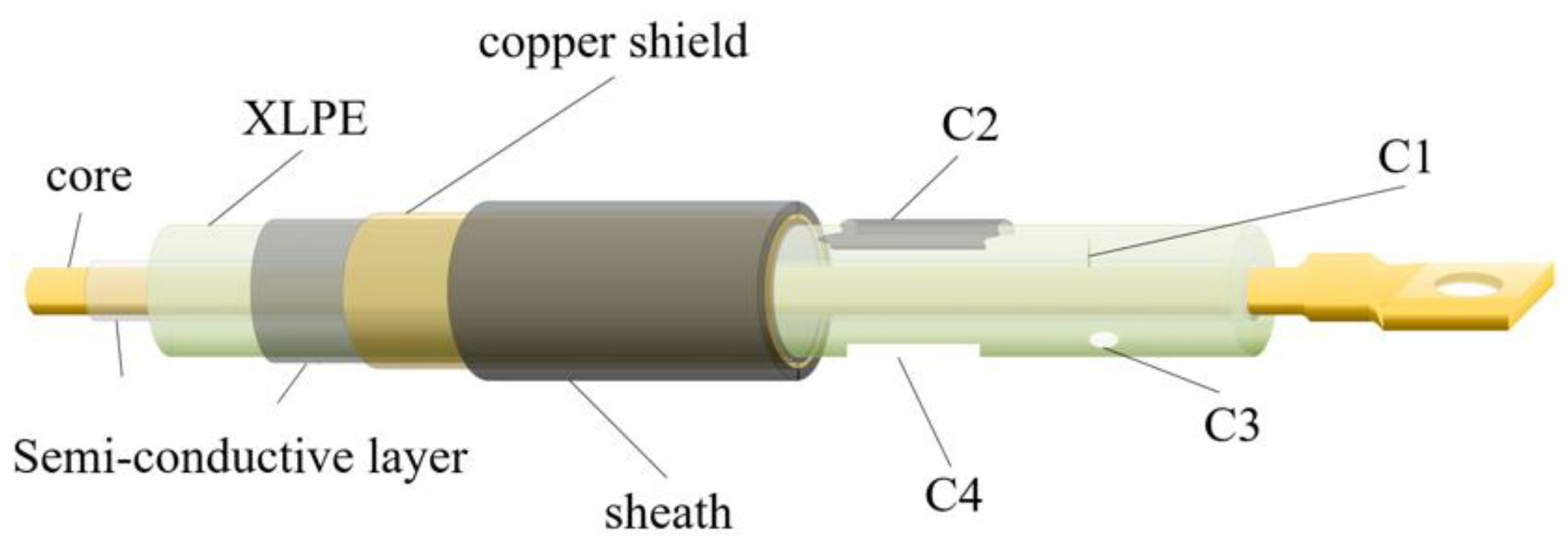
Internal, surface, corona and other discharge mechanisms do not look identical, and interference can imitate them. Persistent insulation degradation can progress toward breakdown or flashover; if an arc event develops, equipment outage, fire and severe personnel hazards become possible. The task is therefore not just pattern recognition—it is evidence preparation for safer engineering decisions.
Input length varies between isolated events and long continuous records.
Measurement units and scales can differ between laboratory and deployment data.
Class imbalance and disputed boundaries affect both loss design and evaluation.
Offline results do not establish cross-customer generalization.
System path
FCN and CNN-BiLSTM paths assign signal type and confidence to short segments
Inspect logits, then normalize units, scales, channels and label semantics before inference
Configurable U-Time-style 1D models use Dice plus cross-entropy and optional wavelet channels
TCN autoencoding learns common noise and routes high-distance intervals to review
Two segmentation routes
U-Time learns an explicit class map from expert interval labels. TCNAE learns the structure of common noise without class labels and turns reconstruction deviations into candidates for review. They produce related timelines, but they do not make the same claim.
Best suited when interval semantics are stable enough to supervise a dense one-dimensional segmentation model.
Slice long records while preserving the mapping between samples, segment labels and source coordinates.
Use the normalized waveform alone or add selected discrete-wavelet bands as synchronized channels.
Configurable 1D convolution and pooling stages enlarge context while reducing temporal resolution.
Upsampling combines bottleneck context with encoder detail before the segment classifier.
Optimize Dice plus cross-entropy, schedule the learning rate, stop early and inspect interval overlap and boundary quality.
Useful when abnormal examples are scarce or their physical labels remain disputed, but common noise can be modeled.
Convert the signal contract, normalize by robust statistics and create overlapping windows whose target is the input itself.
Dilated causal convolutions and residual blocks expand the receptive field without recurrent state.
Concatenate multi-scale TCN features, project them and pool them into a lower-dimensional temporal code.
Reverse-dilation decoder blocks rebuild each window; overlapping predictions are averaged back onto the source timeline.
Use reconstruction residuals as anomaly evidence, then threshold and merge candidate intervals before expert review.
The architecture explanation follows the U-Time and TCN-AE papers. I use those papers to explain the methods, without reusing their benchmark results as results from my project.
Short-window classification
The classifier path keeps feature extraction, variable-length aggregation and final evidence separate so deployment failures can be inspected layer by layer.
Normalized 1D samples
FCN or CNN-BiLSTM representation
GAP/SPP variants explored
Inspect absolute scale before softmax
PD candidate or noise
Near-zero logits pointed to an input contract problem rather than a softmax problem.
Key trade-offs
Near-zero logits exposed a silent unit/scale mismatch; the repair was to make input semantics explicit, not to tune the softmax.
I explored pooling and wavelet-channel variants as controlled model choices, without drawing conclusions from incomparable accuracy measurements.
Unfamiliar patterns are routed to review rather than promoted directly to a physical diagnosis.
04 · A
04 · B
01A sophisticated architecture cannot rescue an undefined measurement contract.
02Boundary quality and abstention behavior matter as much as a headline class score in expert-facing systems.
What I can share
Raw customer data and customer or device context are not public; the figures and text here show aggregated metrics.
Public sources
https://www.mdpi.com/1996-1073/13/17/4566U-Time paper · NeurIPS 2019 https://proceedings.neurips.cc/paper_files/paper/2019/hash/57bafb2c2dfeefba931bb03a835b1fa9-Abstract.htmlTCN-AE anomaly-detection paper · Applied Soft Computing 2021 https://doi.org/10.1016/j.asoc.2021.107751OMICRON guide to partial-discharge measurements https://www.omicronenergy.com/uploads/tx_downloader/51c20/A_Guide_for_PD_Measurements_on_MV_and_HV_apparatus_-_Part1.pdfOSHA arc-flash hazard guidance https://www.osha.gov/sites/default/files/publications/OSHA4475.pdf